
Exclusive cultural experiences
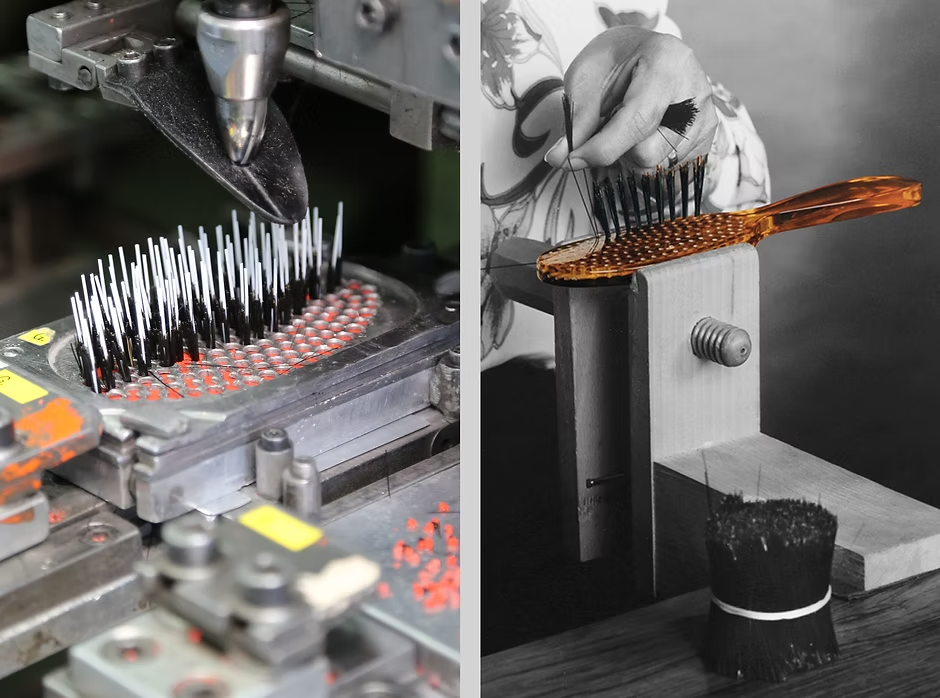
Unique savoir-faire : l'empoilage (tufting)
The craft of tufting is one of those professions that remains difficult to grasp until you have seen it done. In a high-quality brush, it is not simply a matter of “setting bristles” into a handle: one must choose the right amount, maintain the proper rhythm, feel the tension of the material, and ensure an even,balanced placement. At Fournival Altesse, some brushes are stillhand-tufted, with natural bristles secured into the handle using fishing line.To the untrained eye, the gesture may seem almost invisible, yet it demands extreme precision and a long familiarity with the material.
What is striking about tufting is how deeply it engages the body. It is a craft guided as much by touch as by sight. Over time, artisans develop an instinct for the right density, the right pressure, the right regularity. It may appear repetitive, but in truth it is highly exacting work, where even the slightest variation can alter the quality of the brush. In high-end brushmaking, tufting is not a secondary step; it is one of the precise moments in which the nobility of the object is decided.
There are houses whose birthplace tells almost everything about them. Fournival Altesse is one of them. One might assume that a great luxury hairbrush could only be born close to Parisian storefronts, in a district long devoted to appearances and elegance. And yet it was in Mouy, in the Oise region, nestled in a valley shaped more by labor than by society, that such a house took root in 1875. It was there, and nowhere else, that it found what no prestigious setting alone can provide: a territory already prepared by materials, by gesture, and bytime.
Before the brush, there was patience. Around Méru, from as early as the seventeenth century, tabletiers worked with mother-of-pearl, bone, ivory, and wood, in a discipline where precision was not an embellishment but a condition for survival. When hygiene practices expanded in the early nineteenth century and demand for brushes began to rise, the region already possessed what many industries spend years trying to build: hands trained in exacting work. Fournival Altesse did not emerge on untouched ground ; it inherited a world in which meticulousness was ancient, almost instinctive.

The Thérain Valley supplied the rest. Water long provided power there ; nearby Paris offered a market ; and the surrounding countryside supplied a workforce capable of embracing the trade with endurance. By the late nineteenth and early twentieth centuries, the Oise had become one of the great centers of French brushmaking. Within that landscape, Mouy was no geographical accident: it was one of those rare places where technique, circulation, and necessity converged. It was precisely there that Léon-Étienne Fournival founded his workshop in 1875, first devoted to toothbrushes, before the house turned more decisively, beginning in the 1920s, toward high-end hairbrushes.
What makes Fournival Altesse distinctive is not merely its age. Many companies are old ; few know how to survive upheaval without dissolving the very reason they exist. Throughout the twentieth century, brushmaking in the Oise declined. Workshops closed, industrial balances shifted, competition intensified. Fournival remained. It endured because it chose the more demanding path: one in which manufacturing never fully abandons the human hand. In its workshops, machinery exists, of course, but it does not rule alone. Certain operations still require the eye, the touch, the adjustment—that quiet intelligence no production rhythm can ever fully replace.
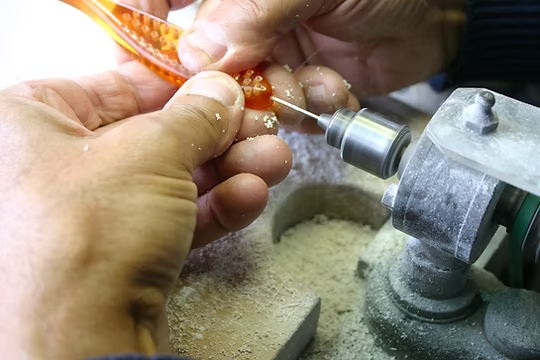
The house has known threat, fragility, and narrow escapes. In 2005, it nearly disappeared before being taken over in order to preserve this technical heritage. Since2016, Julia Tissot-Gaillard has carried that continuity forward, and public recognition later confirmed the singularity of the house with the Entreprise du Patrimoine Vivant label. Today, around 35 people in Mouy continue an activity whose reach extends far beyond the valley, as far as Asia and the United States. The paradox is striking: in a place one might mistake for peripheral, objects are made that embody a deeply French idea of care, permanence, and poise. Source
Fournival Altesse thus tells a story nobler than that of a successful business alone. It reminds us that an object of prestige is not born solely from a market, nor even from style. It is born from a loyal geography, a technical memory, and a succession of human acts of resolve. In Mouy, the brush is not an accessory. It has become the enduring form of a territory that refused to forget what its hands once knew how to make.