
Exclusive cultural experiences
Founded: 1761 by Monsieur Delcourt, confectioner and chocolatier
Location: 27 Rue Esquermoise, 59000 Lille, France (Old Lille)
→ Boutique listed as a Historic Monument (interior décor and storefront, 1980)
Workforce: Approximately 80 employees, including artisan chocolatiers, pastry chefs, confectioners, and tea room and restaurant teams
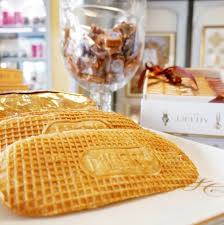
Signature Technique: Vanilla-filled waffle (created in 1849 by Michael Paulus Gislinus Méert), with a recipe unchanged for 176 years. A brioche-style dough is baked, sliced horizontally, and filled with a blend of vanilla, sugar, and butter.
Note: The vanilla used today comes from Madagascar, but in 1849 only Mexican vanilla was available in Europe, as Malagasy vanilla was not introduced until 1880–1881.
Distinctive Identity: One of the oldest pastry and confectionery houses in the world still in operation. Official purveyor to King Leopold I of Belgium (1864). Lavish 1839 décor by architect Charles Benvignat, painter Charles Stalars, and sculptor Félix Huidiez.

There are certain addresses where History does not merely pass through—it settles in.
27 Rue Esquermoise in Lille is one of them. Since 1761, sugar, vanilla,chocolate, and gilded dreams have been sold there. Even today, Méert still makes its filled waffles according to the very same recipe, unchanged since 1849.
But how does a confectionery founded in the eighteenth century endure for nearly 300 years without faltering? Why precisely there, on that cobbled street in Old Lille? And how does a simple waffle become Charles de Gaulle’s favorite dessert, the official purveyor to the King of the Belgians, and one of the oldest pastry houses in the world still in business?
The story begins with a convergence.
Not of the stars, but of a place.
1761–1849: When Lille Tasted of Vanilla and Smelled of Money
In 1761,when Monsieur Delcourt established himself as a confectioner and chocolatier at 27 Rue Esquermoise, Lille was thriving. The city was the Flemish capital of bourgeois prosperity: textile mills were running at full speed, the sugar tradewas enriching merchants, and aristocratic drawing rooms were glittering withrefinement. Along Rue Esquermoise, in the beating heart of Old Lille, noble families, wealthy traders, and dignitaries paraded by.
Delcourt knew exactly where to set up shop. Here, one did not sell bread; one soldedible luxury: chocolate, sweets, liqueurs. Exotic raw materials—Mexicanvanilla, cocoa, rare spices—passed through France’s great Atlantic ports—Le Havre, Bordeaux, Nantes, Saint-Malo—before making their way north along inland trade and river networks. Lille, a commercial crossroads between France, Flanders, and the rest of Europe, became a redistribution hub for these treasures from afar.
In 1773, Modo de Rollez took over the boutique. A renowned ice cream maker, distiller and liqueur specialist, he expanded the range and attracted an ever more distinguished clientele. Then, in 1839, he made a bold move: he commissioned architect Charles Benvignat, painter Charles Stalars, and sculptor FélixHuidiez to transform the shop into a temple of indulgence. Gilding, coffered ceilings, precious woods, veined turquoise marble, a wrought-iron balcony bearing Rollez’s “R”: the interior became a dazzling jewel box, officially listed as a historic monument in 1980.
Then came 1849.
And with it, a Belgian by the name of Michael Paulus Gislinus Méert.
1849: The Invention That Would Never Change Again
Méert took over the business and created the vanilla-filled waffle. Abrioche-like dough, baked, sliced horizontally, then filled with a blend of sugar, vanilla, and butter. Nothing more. Nothing less. For 176 years, the recipe has not changed by so much as a gram.
At the time, vanilla came from Mexico—the Aztec birthplace of the spice, brought to Europe by Spanish conquistadors in the sixteenth century. This rare and costly ingredient passed through the great French Atlantic ports—Le Havre, the leading colonial importer, followed by Nantes and Bordeaux—before being distributed inland. For confectioners in Lille, sourcing vanilla required both strong commercial connections and a clientele wealthy enough to afford it.
Why didthis particular waffle become iconic?
Because it crystallized a perfect territorial convergence:
In 1864, a masterstroke: Méert became official purveyor to His Majesty King Leopold I of Belgium. The waffle from Lille entered royal courts. It would never leave them again.
1900–2025: Transmission, Prestige, and Quiet Radiance
In 1900, the Cardon family acquired the house and preserved the Méert name, now inseparable from the waffle itself. In 1909, a tea room was added. In 1948, a second followed. Throughout the twentieth century, Méert weathered wars,crises, and economic upheavals without ever closing its doors.
Royals,artists, writers, and political figures all made their way down Rue Esquermoise: Napoleon, Buffalo Bill, the Bourbon-Parma and Orléans royal families, Winston Churchill, Jackie Kennedy, Marguerite Yourcenar, AmélieNothomb, Dany Boon… Charles de Gaulle had Méert waffles delivered regularly to the Élysée Palace.
In 1996, real-estate developer Paul-Henri Guermonprez and chartered accountant Thierry Landron acquired the house. They launched its expansion: a tea room in Brussels in 2001, in the Galerie du Roi; a first Paris boutique in 2010 on Rue Elzévir in the Marais; then Rue Debelleyme in 2024; and a corner at La Grande Épicerie in the 7th arrondissement. In 2010, Méert represented French gastronomy at the Shanghai World Expo.
A fine-dining restaurant opened in 2008 on Rue Nationale in Lille. The house developed its EphéMéert collection—seasonal waffles with ever-changing flavors such as speculoos, strawberry-Vichy, and violet-blackcurrant. Yet at its heart, the 1849 vanilla waffle has remained untouched.
An important historical note: if Méert now speaks of “Madagascar vanilla,” that is a much later addition. Malagasy vanilla was not introduced to Madagascar until around1880–1881 by growers from Réunion, more than thirty years after the creation of the Méert waffle. The original 1849 recipe used Mexican vanilla, the only source available in Europe at the time.
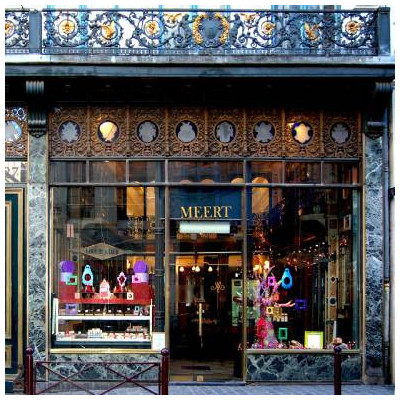
Today,within this 1839 décor, listed as a historic monument, every Méert waffle tells the story of a place that learned how to turn sugar and vanilla into living heritage. And despite its expansion into Paris and Brussels, it has never truly left 27 Rue Esquermoise.
Because some addresses do not relocate.
They become destinations.